Project Overview
AR-TEC completed the seismic assessment of 22 important educational and healthcare buildings as part of a Government of Oman initiative to evaluate the safety of existing public infrastructure in the Sur region. The engineering work was led and handled by Bush RC.
The assessed portfolio consisted of 14 school buildings, 5 hospital buildings and 3 university buildings. Each facility had a different footprint, number of storeys and structural arrangement; therefore, every building was studied and modelled separately.
The objective was to understand how the buildings would respond during an earthquake, where structural damage could develop and which facilities might require further investigation or strengthening. The assessment went beyond a conventional elastic design check and examined the behaviour of the structures after the onset of cracking, yielding and stiffness degradation.
Where complete original drawings were unavailable, the structural arrangement was interpreted using site information, building photographs, available dimensions, satellite imagery and visible beam-column layouts. These observations were used to establish representative building geometry, storey levels, member orientation, structural load paths and stiffness distribution.
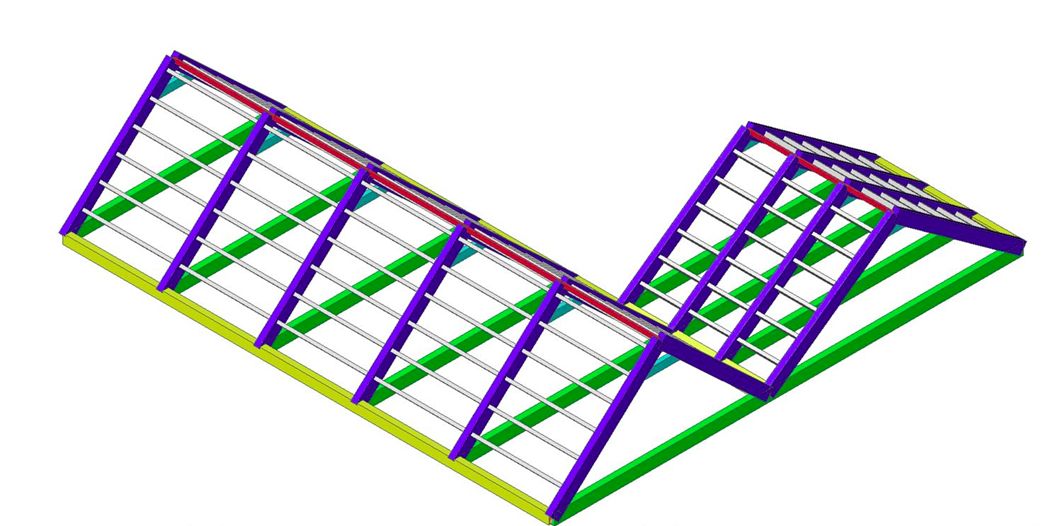
Individual three-dimensional structural models were developed in ETABS 2022 for all 22 buildings. The models included the reinforced-concrete framing system, beam-column connections, floor levels, gravity loading, occupancy loading and the additional mass contributed by masonry walls.
The seismic demand for the Sur region was evaluated by considering the influence of surrounding earthquake sources, including the Makran Subduction Zone, the Zagros seismic region, the Oman Mountains and the Gulf of Oman. Probabilistic Seismic Hazard Analysis was used to establish suitable ground-motion parameters for the performance assessment.
Nonlinear material behaviour was incorporated into the structural models to represent the response of concrete and reinforcing steel more realistically. The modelling considered confined and unconfined concrete, reinforcing-steel yielding, cyclic degradation, loss of stiffness and the formation of plastic hinges in beams and columns.
Pushover analysis was performed to determine the lateral strength, stiffness and deformation capacity of each building. The analysis helped identify the performance point, sequence of yielding, possible weak storeys, critical structural members and locations where damage was likely to concentrate.
Nonlinear time-history analysis was carried out using a selected suite of recorded earthquake ground motions. The records were normalised and scaled to evaluate the response of the buildings under realistic earthquake shaking with different frequency characteristics and intensity levels.
The time-history results were used to examine peak interstorey drift, total displacement, residual deformation, beam and column forces, plastic rotations, structural damage patterns and the progressive reduction of strength and stiffness during cyclic loading.
Incremental Dynamic Analysis was also performed by gradually increasing the intensity of the earthquake records. This allowed AR-TEC to study the complete response of each building, from its initial elastic behaviour through nonlinear damage development and, where applicable, the point of dynamic instability or collapse.
Fragility assessment was used to estimate the probability of the buildings reaching different structural damage levels at increasing earthquake intensities. This provided a consistent basis for comparing the relative vulnerability of all 22 facilities.
The assessment examined global stability, structural regularity, lateral stiffness, storey drift, residual displacement, beam and column performance, plastic-hinge development, ductility demand, damage progression and collapse capacity.
The completed study provided a building-by-building understanding of the current seismic vulnerability of the selected schools, hospitals and university facilities. It created a technical basis for prioritising detailed inspections, strengthening measures, rehabilitation planning and future seismic-risk reduction.
This project demonstrates AR-TEC’s ability to manage large-scale assessment programmes involving multiple existing buildings, limited original information and advanced performance-based seismic analysis. By combining engineering judgement with detailed numerical modelling, AR-TEC delivered practical information to support safer and more resilient public infrastructure in Oman.


 Completed